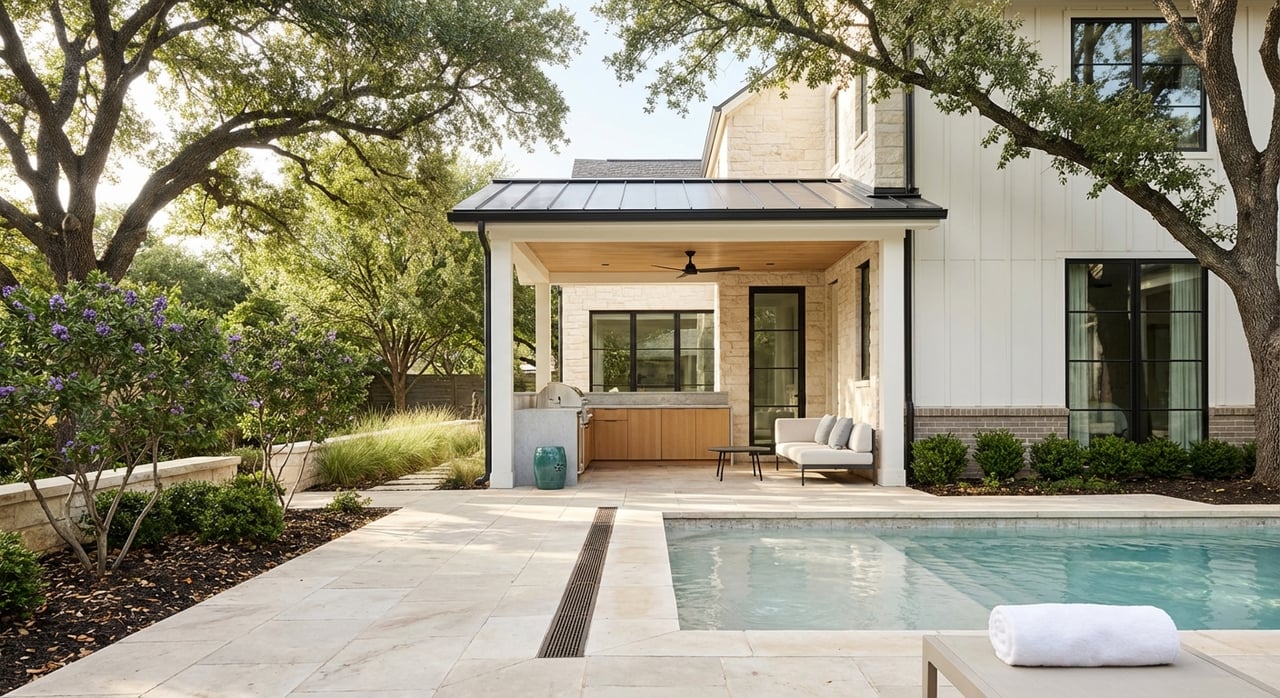
Is your Bluffview backyard doing all it can for your daily life? With mature oaks, generous lots, and gentle slopes, homes in Bluffview at Camino Real are primed for outdoor spaces that feel like a natural extension of your interiors. You want shade that works, materials that last, and a layout that fits dinners with friends as well as quiet mornings with coffee. In this guide, you’ll learn how to design patios, terraces, pools, and planting that suit Bluffview’s terrain and San Antonio’s climate. Let’s dive in.
Know your Bluffview lot
Bluffview at Camino Real features established single-family homes on larger suburban lots with mature tree canopy. Many parcels fall under HOA oversight, so start by reviewing your deed restrictions and any architectural guidelines before you sketch a plan. That early check can save you time and rework.
Walk your yard with a simple checklist:
- Note sun and shade patterns across the day, especially west exposures.
- Mark mature trees and root zones you want to protect.
- Observe grade changes to spot potential terraces and natural gathering zones.
- Identify existing hardscape you may keep, resurface, or convert to permeable materials.
- Flag neighbor sightlines where layered planting can add privacy.
Design for San Antonio’s climate
San Antonio brings hot summers, mild winters, and most rainfall in late spring and early summer. Typical summer highs reach the 90s Fahrenheit, and annual precipitation sits in the low 30s inches, based on long-term normals for the metro area. You can review the local climate data to plan shade, surfaces, and pool comfort using NOAA-based climate normals.
Bluffview falls within USDA Hardiness Zones 8b to 9a. That range shapes what survives winter chills, especially in containers or exposed areas. See a regional overview of Texas hardiness zones when selecting trees and ornamentals.
A few climate-smart moves pay off fast:
- Use shade intentionally. Mature oaks are assets. Shading west and south exposures can reduce heat gain outdoors and inside. The EPA summarizes tree cooling benefits that translate directly to comfort and lower energy use.
- Mix covered and open areas. Pair a roofed porch or pergola with open sky for winter sun.
- Choose lighter-toned, UV-stable surfaces in high-sun areas to keep foot temperatures down.
- Group plants by water needs and irrigate efficiently to handle heat waves.
Work with slope and soil
Bluffview sits near Hill Country geology where you often encounter limestone-influenced soils, rocky pockets, and thin soil on slopes. That affects planting success, drainage, and how you terrace or retain grade. For background on regional soils and why they matter, review this overview of Texas soil surveys and geology.
On sloped lots, treat grade as a design feature, not a problem:
- Break the yard into terraces. A primary level patio connects to indoor living, with steps to secondary terraces for lounging, play, or a pool.
- Favor short, well-detailed retaining walls or stacked stone that read as landscape features.
- Stabilize slopes with grasses and groundcovers.
- Keep heavy equipment away from critical root zones of mature trees.
Stormwater should be managed on site. Small-scale green infrastructure slows runoff and boosts infiltration:
- Add bioswales along contour to move water gently through the yard.
- Use permeable pavers where appropriate so water soaks in.
- Create rain gardens below downspouts. The EPA’s green infrastructure guidance highlights simple strategies that reduce erosion and maintenance.
Patio and terrace planning
Think in zones. Start with the activities you want to support, then size each surface to match.
- Dining patio: allow space for a table and chairs for 6 to 8 plus pull-back room.
- Lounge terrace: plan for sectional seating, a coffee table, and clear walk paths.
- Grill station: keep hot zones away from play areas and windows.
- Transition steps: generous treads and integrated lighting for safety.
Material choices that fit Bluffview and the Hill Country look:
- Natural limestone or warm-toned pavers for a regional palette.
- Permeable pavers or gravel-set stone to reduce runoff and reflect heat.
- Exposed aggregate or textured concrete with expansion joints that double as design lines.
Consider partial cover for summer comfort. A pergola with climbing vines or a roofed porch adjacent to the main patio gives you shade while keeping sky views.
Pools and water features
Pool placement should follow your grade, views, and access. On rolling lots, a lower terrace often works best for gravity and privacy, while elevated sites can host a negative-edge feature to frame views. Always plan around existing trees and root zones to avoid removals and long-term stress to your canopy.
Safety and code come first. Most municipalities that adopt the International Swimming Pool and Spa Code require barriers of a certain height, self-closing and self-latching gates, and thoughtful detailing to prevent climbing. Review ISPSC guidance on residential pool compliance and verify local adoption.
Permits and local review are part of the process in San Antonio. Expect to show site plans, setbacks, structural details, and barrier specs. A practical overview of homeowner steps in the San Antonio area is available here: navigating the permit process. Also check HOA rules early for any pool-specific guidelines.
Outdoor kitchens and fire features
Anchor your kitchen to the main patio for easy hosting and indoor-outdoor flow. Plan for code-required clearances from combustibles, service access for gas and electrical, and durable, heat-resistant finishes. Keep hot appliances away from children’s play zones and high-traffic paths. For year-round use, include task lighting, a prep counter, and storage for covers and tools.
If you add a fire pit or fireplace, place it where smoke will not drift into interiors or neighbor areas. Choose gas where local rules or comfort make open wood fires impractical.
Lighting for Hill Country nights
Layer low-voltage LED lighting so paths, steps, and tasks are safe without glare. Uplight specimen trees lightly and shield fixtures to protect the night sky and your neighbors’ comfort. Warm-white color temperatures create a welcoming tone and help materials read naturally.
Plant palette that thrives
Choose plants adapted to central Texas heat, periodic drought, and alkaline soils. When you hydrozone, you reduce water use and simplify care. Local programs also encourage low-water landscapes. Explore SAWS’ WaterSaver coupons and landscape incentives.
Use this palette as a starting point, then tailor to your light, soil depth, and goals:
- Canopy trees for shade and structure: live oak, Lacey oak, cedar elm. New placements on west exposures help cool patios and interiors.
- Small and ornamental trees for seasonal interest: Mexican plum, Texas redbud.
- Screening and structure shrubs: yaupon holly, American beautyberry, and mountain laurel for evergreen form. Texas sage is a low-maintenance, drought-tolerant option that performs well as a screen; see a practical profile of Texas sage.
- Grasses and perennials for texture and erosion control: muhly grasses, red yucca, salvia, and native asters. For color and slope stability, hair-awn muhly is a standout; learn more about muhly grasses.
- Groundcovers and lawn alternatives for sunny slopes: frogfruit, native lantana, and blackfoot daisy.
Plant in layered bands to balance privacy and daylight. Combine evergreen backbones with seasonal bloomers out front to keep views open and interesting year-round.
Build smart: process checklist
Avoid surprises by following a clear sequence from idea to install:
- Confirm rules.
- Review your HOA design guidelines and any neighborhood architectural review requirements.
- Order a site survey.
- A topographic and tree survey shows slope, utilities, easements, and critical root zones. Use it to place patios, terraces, and a pool.
- Check permits early.
- Contact the City of San Antonio’s Development Services to confirm triggers for pool, exterior structures, retaining walls, and tree work. A concise overview of typical steps can be found in this San Antonio permit guide.
- Leverage rebates.
- Apply for SAWS incentives early if you plan to convert turf to beds, add permeable hardscape, or install cisterns. Many programs require pre-approval or documentation. Start with WaterSaver programs.
- Hire the right team.
- For pools or significant grade changes, engage a landscape designer and licensed contractors, plus geotechnical or structural pros when walls are engineered. Ask about experience with sloped Hill Country sites and tree protection.
Bring your vision home
When you work with your site, honor the shade you already have, and choose materials that fit the Hill Country spirit, your outdoor spaces feel effortless. Start small with a primary patio that flows from your living room, then add terraces, a water feature, and layered planting over time. Smart permits and rebates can keep the process smooth and cost-effective. If you want a sounding board on where outdoor investments matter most for resale, reach out. You’ll get clear, construction-informed guidance tailored to your goals.
Ready to align your outdoor upgrades with your next move. Connect with Donna Hartley to Schedule a Free Consultation.
FAQs
Do I need a permit for patios, decks, or pools in Bluffview at Camino Real?
- Pools and many exterior structures require permits, while small walkways or decorative patios may be exempt; always check the City’s Development Services and your HOA first, and review this overview of San Antonio’s permit process.
What plants handle heat and limestone soils in San Antonio backyards?
- Choose native or well-adapted options like live oak, cedar elm, Texas sage, muhly grasses, red yucca, and native lantana, and group them by water needs to reduce irrigation; SAWS’ WaterSaver resources are a good starting point.
How can I keep a patio cooler in summer without overbuilding?
- Combine tree shade with a partially covered patio, pick light-toned pavers, and place seating to catch breezes; the EPA’s summary of tree cooling benefits shows how strategic canopy lowers ambient temperatures.
Where should a pool go on a sloped Bluffview lot?
- A lower terrace often simplifies access and grading, while elevated sites can support a negative-edge design for views; in both cases, plan around tree root zones and consult licensed pros for engineered walls and code-compliant barriers, referencing ISPSC pool safety guidance.
